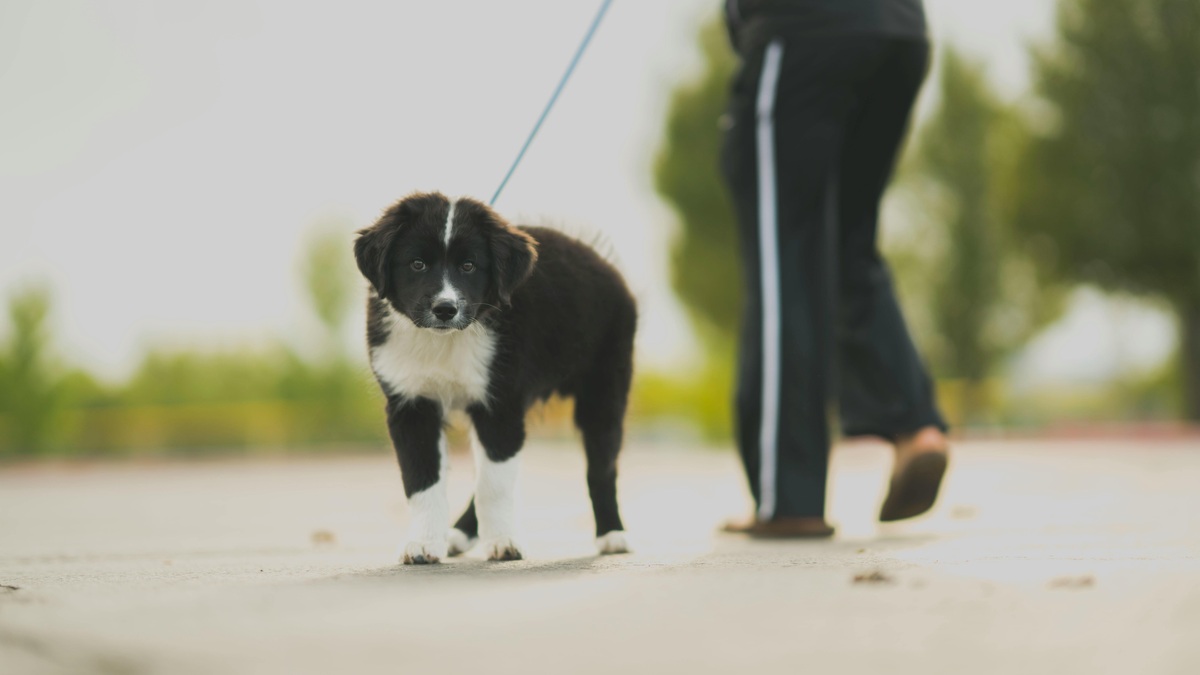
If walking your puppy feels more like being dragged down the street than enjoying a calm stroll, you’re not alone.
Loose leash walking is one of the most commonly requested training skills — and one of the most misunderstood. Many puppy owners expect their puppy to “just know” how to walk nicely on lead, but the truth is walking on a loose leash is a learned skill, not a natural one.
The good news? With the right approach, timing, and rewards, your puppy can learn to walk politely beside you.
What Does “Loose Leash Walking” Actually Mean?
Loose leash walking simply means:
- The leash stays relaxed (no tension)
- Your puppy is not pulling you forward
- Your puppy can move, sniff, and explore without dragging you
It does not mean:
- Perfect heel position
- No sniffing
- Your puppy must stay glued to your leg
For puppies, loose leash walking is about learning how to move together, not about strict control.
WHO Is Responsible for Teaching Loose Leash Walking?
Loose leash walking is a human-led skill. Puppies pull because:
- They walk faster than we do
- They get reinforced for pulling (they reach what they want)
- They haven’t been taught another option
Everyone who walks the puppy should use the same rules and rewards. If one person allows pulling “just this once”, the puppy learns that pulling sometimes works — and that’s enough to keep the behaviour going.
WHAT Should You Reward During Loose Leash Walking?
You’re not just rewarding where your puppy is — you’re rewarding what the leash feels like.
Reward your puppy for:
- The leash being loose
- Walking near you
- Checking in with you
- Choosing not to pull toward distractions
Real-life example:
Your puppy glances back at you while walking → reward.
That moment of attention is a fantastic choice worth reinforcing.
Food is usually the most effective reward when teaching loose leash walking, especially in the early stages or in distracting environments.
WHERE Should You Practise?
Start where your puppy can succeed.
Loose leash walking should begin:
- Inside the house
- In the backyard or driveway
- In quiet, familiar areas
Only once your puppy understands the basics should you move to:
- Busier streets
- Parks
- New environments
Real-life example:
If your puppy pulls constantly at the park but walks well at home, that’s not disobedience — it’s information. The park is simply too hard right now.
WHEN Should You Reward?
Timing is critical.
Reward:
- As soon as the leash goes slack
- While your puppy is walking without tension
- The moment your puppy turns back toward you
Real-life example:
Your puppy pulls toward a tree, then turns back and loosens the leash — that moment is what you reward.
Waiting until you’ve walked several more steps often means the puppy has no idea what earned the reward.
HOW Do You Teach Loose Leash Walking?
Think of loose leash walking as a conversation, not a correction.
Here’s a simple, puppy-friendly approach:
- Start walking
- The leash goes tight → stop moving
- The leash loosens → mark (“Yes!”) and reward
- Continue walking
This teaches your puppy that:
- Pulling makes movement stop
- A loose leash makes the walk continue
Real-life example:
Your puppy pulls toward another dog. You stop. They turn back toward you. You reward and move forward. Over time, your puppy learns that checking in works better than pulling.
Rewarding Good Choices on Walks
Some of the most important rewards happen when you didn’t ask for anything.
Reward your puppy when they:
- Walk past another dog calmly
- Choose to sniff without pulling
- Recover quickly from a distraction
- Walk nicely on a longer leash
These moments teach your puppy that self-control pays off.
Common Loose Leash Walking Mistakes
Many well-meaning puppy owners accidentally make pulling stronger by:
- Continuing to walk while the puppy pulls
- Only rewarding when the puppy is perfectly positioned
- Expecting long walks too early
- Using equipment without training
Loose leash walking is built through many short, successful repetitions, not long, frustrating walks.
What About Sniffing?
Sniffing is normal, healthy, and important for puppies.
You don’t need to stop your puppy from sniffing — you just need to teach them how to sniff without pulling.
Real-life example:
If your puppy walks nicely for a few steps, allow them to sniff as a reward. The environment itself can be one of the most powerful reinforcers.
Expert tip: Put sniff on cue for walks. If puppy is walking nice on the lead, give him a reward of ‘go sniff’ which is giving him permission to explore.
Loose Leash Walking Builds More Than Manners
When taught kindly and clearly, loose leash walking helps puppies learn:
- Self-regulation
- Frustration tolerance
- How to stay connected to their handler
- That humans are predictable and fair
These skills carry over into many other areas of life.
Final Thought
If walking feels hard right now, remember: your puppy isn’t giving you a hard time — they’re having a hard time.
Reward the moments you want to see more of, keep your expectations realistic, and celebrate small improvements. Loose leash walking isn’t about perfection — it’s about progress.
Loose Leash Walking: Troubleshooting & Common Questions
Even when you’re doing “everything right”, loose leash walking can still feel messy at times. Puppies are learning, environments change, and progress is rarely a straight line. These are some of the most common questions and issues puppy owners raise — and what to do about them.
“My puppy pulls constantly — am I doing something wrong?”
Probably not.
Pulling usually means:
- The environment is too exciting
- The walk is too long
- The rewards aren’t valuable enough for that situation
What helps:
Go back to easier locations, shorten walks, and increase reward value. Loose leash walking needs to be taught before asking your puppy to handle distractions.
“My puppy walks nicely at home but pulls everywhere else.”
This is extremely common.
Puppies don’t automatically generalise skills. Walking nicely in the lounge room does not mean they understand how to do it at the park.
What helps:
Think in levels:
- Home
- Driveway
- Quiet street
- Busier areas
Reward heavily each time you move up a level.
“My puppy pulls toward other dogs or people.”
This is usually excitement, not bad behaviour.
From your puppy’s perspective, pulling has worked in the past — it helped them get closer to something they wanted.
What helps:
- Increase distance from the trigger
- Reward check-ins and calm behaviour
- Avoid allowing your puppy to reach dogs or people by pulling
If pulling sometimes works, it will keep happening.
“Should I stop walking when my puppy pulls?”
Yes — but calmly and consistently.
Stopping teaches your puppy that pulling doesn’t move them forward. The key is to:
- Stay quiet
- Wait for the leash to loosen
- Reward that moment
Yanking, scolding, or dragging your puppy only creates frustration and confusion.
“My puppy just sits or refuses to move.”
This often means the puppy is:
- Overwhelmed
- Tired
- Unsure what to do next
What helps:
- Reduce pressure
- Use encouragement, not force
- Reward any small movement toward you
Loose leash walking should feel safe, not stressful.
“My puppy is worse at the end of the walk.”
That’s usually fatigue.
Puppies have limited attention spans and self-control. When they’re tired, skills fall apart.
What helps:
Shorten walks and aim to finish while your puppy is still doing well. Several short, successful walks are far more effective than one long, frustrating one.
“Can I let my puppy sniff?”
Absolutely — sniffing is important and healthy.
The goal isn’t to stop sniffing, but to teach your puppy how to sniff without pulling.
What helps:
Use sniffing as a reward. If your puppy walks nicely for a few steps, let them sniff. The environment itself can be one of the most powerful reinforcers you have.
“Do I need special equipment to stop pulling?”
Equipment can help with management, but it doesn’t teach the skill.
No harness, collar, or lead will replace training. If your puppy doesn’t understand loose leash walking, changing equipment alone won’t solve the problem.
What helps:
Focus on teaching the behaviour first. Equipment should support training, not replace it.
“How long does loose leash walking take to learn?”
It depends on:
- Your puppy’s age
- The environment
- How consistent the training is
- How realistic expectations are
Loose leash walking is a long-term skill, not a quick fix. Progress often looks like fewer pulls, faster recovery, and better focus — not perfection.
“What if my puppy just won’t improve?”
If progress feels stalled:
- Reduce distractions
- Increase reward value
- Shorten sessions
- Get professional guidance
Sometimes small changes in timing or setup make a big difference.
A Final Reassurance
Loose leash walking is one of the hardest skills for puppies to learn — not because they’re stubborn, but because the world is exciting.
If your walks feel inconsistent, you’re not failing. You’re training.
Celebrate small improvements, reward good choices, and remember: every loose step is a step in the right direction 🐾